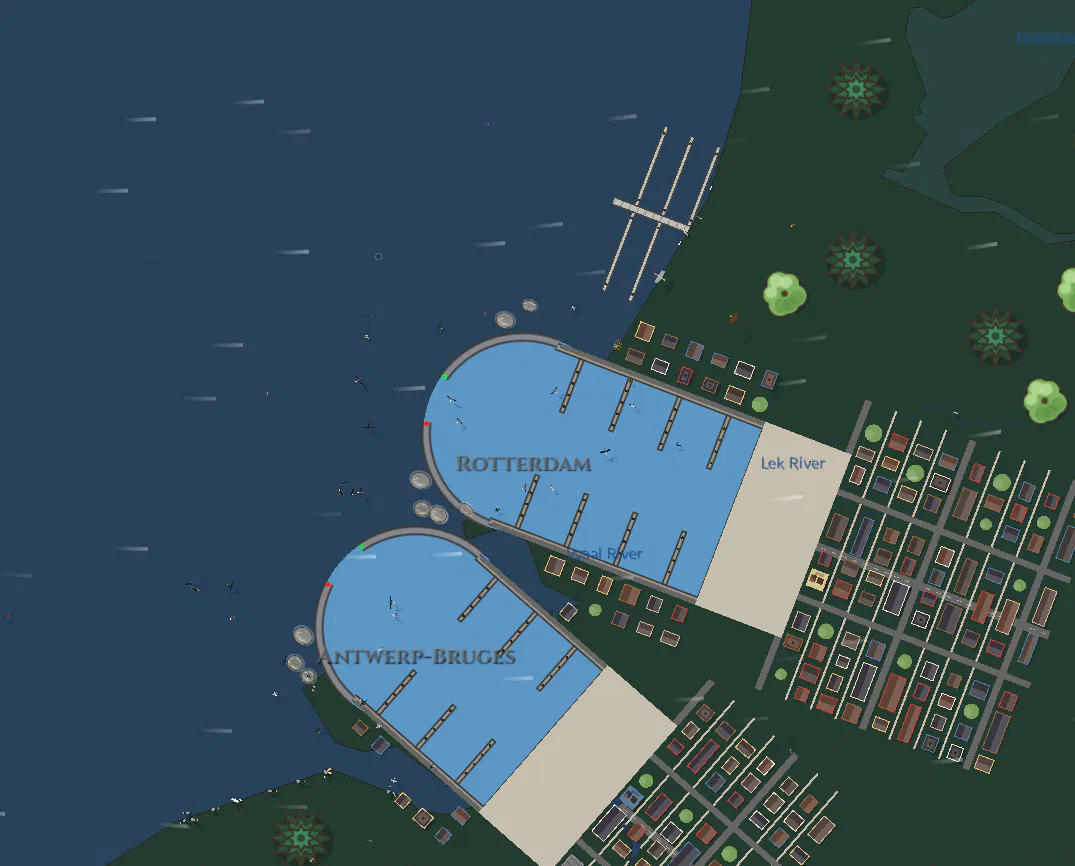
Rotterdam and Antwerp-Bruges: basins, piers and towns
The Tug: a small black tug, drawn at sea with a fender all round, a white wheelhouse and a funnel. Docked, a tug moors along the inside of its marina's jetty, not at the anchorage: each in its own slot (the first free one, kept till it leaves), the two arms by turns, from a little over halfway round each arm (54 degrees from the entrance) towards the entrance, 0.6 dock units apart, bow towards it; with those all taken, on round towards the arms' land ends. It comes home from just inside the entrance across the outer harbour to the land end of its own arm and along the arm to its slot, and leaves along the arm to just inside the entrance and out, so it never crosses the jetty, the basin's corners or the pier tips (on the gray route map, a small black tick across the port's outline, reaching a little inside and out of it, side by side 3 px apart at the top). A service ship like recovery boats: no route or cargo, pays its own fuel and repairs, never lost, no breakdowns.
Slots come from the routes, not levels: two for each port on any cargo ship's route, e.g. one ship on Rotterdam-Hamburg allows 4. The Shop card says "Owned 1 / 4 (2 per route port)", and when they're full the button says "Route to more ports for more". With no routes yet, buying explains that tugs are based at the ports on your routes.
Each new tug launches straight at the route port with the fewest tugs (ties: the port on the most ships' routes), so they spread evenly; the buy popup shows where (the port can't be picked). When the routes change, a tug at a port no longer on any route (or over its port's two) is re-based to the nearest route port still short of tugs that a full tank (1,500 nm) can reach, and sails there once free; with nowhere to go it stays put.
Job: a ship lost within a tug's reach (150 nm along its lane, +15% per Range upgrade) of either end of its leg is fetched by the free tugs (docked at their base, with the fuel) based at the nearer end, up to two, before any recovery boat is sent (auto-recovery and the Send Recovery button alike; the button shows "Tugger and Puller → Rotterdam, about 43 s"). They sail out along the lane one after the other (the second leaves 1.5 s after the first, "Following Tugger out to tow Hauler", so they head out in line), stop short ahead of the ship's bow, turn round on a turning circle to face home (3 s), and once both have, tow it in. Both pull from ahead of its bow on tow lines (1.2 tug lengths): one tug on a single line, two side by side in a tight Y, their lines from the bow the same length. Each tows at half its speed, added up, so two bring a ship in twice as fast as one. The towed ship comes round from the way it lay to the way it's towed over its first 3 nm. At the tugs' port the ship is handed over (paid as usual if that's where it was going, else nothing), and the tugs bring it in:
With a berth free (it takes one at once, as it would next step): they pull it straight in through the mouth, through the outer harbour and down the channel to where it comes round for its slot. There they let go, easing to a stop beside it, away from its slot and inside the channel, clear of the pier tips (where the channel is too narrow for the second tug beside the first it stops behind it; "Bringing Hauler alongside at Rotterdam"), and lie there while it goes on in by itself at half speed, round into its slot and the last slide onto its pier; then they go out along the channel's middle and home by their arm's land end to their moorings. Its time coming alongside is all this.
With no berth free: they cast off at the harbour mouth and go in to their moorings by their arm's land end; the ship glides on to its spot at the anchorage to wait for a berth, as any ship coming in to wait does.
Tugs always go the way they face, as boats do (never sideways): along their lanes and the tow's track (the lane, the curve into the harbour, on in through the mouth), round smooth turns (0.7 of their length), backing straight off at most. Every move is worked out ahead from the ship's own way in, so each tug's track is smooth from heading out to docking again.
Upgrades: tugs level up from their jobs, and spend points on Speed, Range (reach +15%) and Efficiency (fuel), in place of Durability.
Statuses: "Standing by at Rotterdam", "Heading out to tow Hauler", "Turning round to take Hauler in tow", "Waiting for Puller to take Hauler in tow", "Towing Hauler to Rotterdam with Puller", "Bringing Hauler alongside at Rotterdam with Puller", and on the towed ship "Being towed to Rotterdam by Tugger and Puller". The activity log says "Auto-recovery: Tugger and Puller sent out from Rotterdam for Hauler (about $339)" and "Tugger and Puller towed Hauler in to Rotterdam". A tow under way is saved with the game.
Tugs show in the Shop's Tugs section, the Ships tab's "Recovery boats and tugs" filter and Finances' Tugs group; a tile reads "Tug at Rotterdam · Lv 2".
Tugs cost 20% less for every third of the field guide's animals the company has seen, for every tug bought from then on, Buy All Tugs too; the Shop's tug card shows "$40,000 (20% off: animals seen)", its price's tooltip how it works.
 Maritime Empire