 Maritime Empire
Ship models
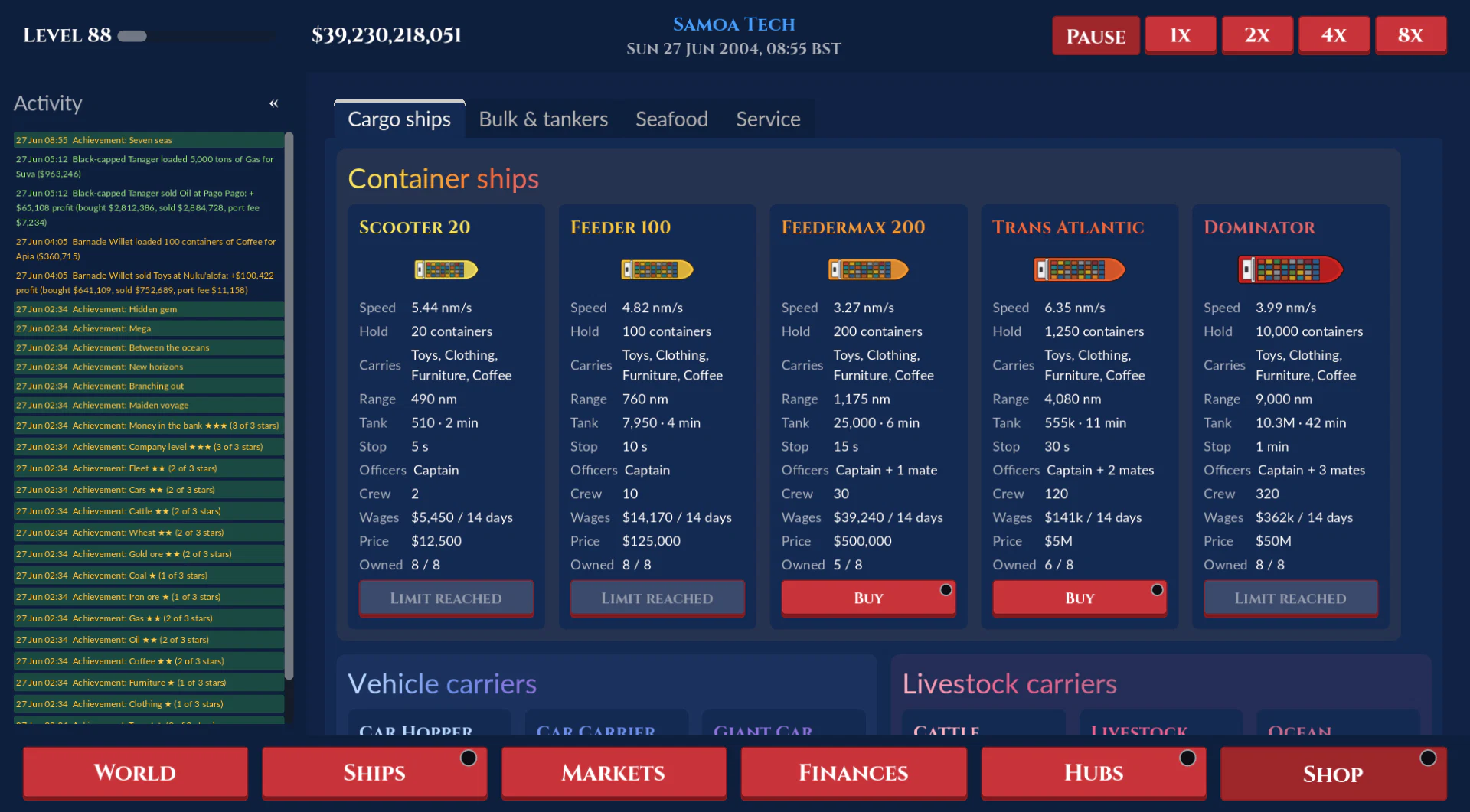
- Six lines: container ships (Scooter 20, Feeder 100, Feedermax 200, Trans Atlantic, Dominator), tankers (Bunker Tanker L4, Lake Tanker L9, Coastal, Aframax, Supertanker), and new ore carriers (Laker L2, Panamax Bulker L20, Capesize L45), grain carriers (Grain Laker L8, Kamsarmax L28, Post-Panamax Bulker L52), livestock carriers (Cattle Coaster L12, Livestock Carrier L30, Ocean Shearer L55) and vehicle carriers (Car Hopper L18, Car Carrier L38, Giant Car Carrier L58), plus the recovery boats. The Scooter 20 now carries 20 containers (up from 15, with no change to its fuel use). Seaway-sized models (by length): Scooter, Feeder, Feedermax, Bunker Tanker, Lake Tanker, Coastal, Laker, Grain Laker, Cattle Coaster, Livestock Carrier, Car Hopper and the Buffalo (which can now also carry the small new models).
| Model | Price | Speed (nm/s) | Capacity | Range per leg | Max owned |
|---|---|---|---|---|---|
| Scooter 20 | $12,500 | 5.44 | 20 | 613 nm (≈1 min 53 s) | 8 |
| Feeder 100 | $125,000 | 4.82 | 100 | 950 nm (≈3 min 20 s) | 8 |
| Feedermax 200 | $500,000 | 3.27 | 200 | 1,469 nm (≈7 min 30 s) | 8 |
| Trans Atlantic | $5,000,000 | 6.35 | 1,250 | 5,100 nm (Rome→New York is 4,073 nm) | 8 |
| Dominator | $50,000,000 | 3.99 | 10,000 | 11,250 nm | 8 |
| Buffalo | $1,250,000 | 6.35 | carries 1 lost Scooter 20, Feeder 100, Feedermax 200, Bunker Tanker, Lake Tanker or Coastal | recovery jobs up to 8,000 nm | 8 |
| Bunker Tanker (gas tanker, L4) | $40,000 | 5.60 | 250 tons of fuel | 613 nm | 8 |
| Lake Tanker (gas tanker, L9) | $250,000 | 5.20 | 1,500 tons of fuel | 950 nm | 8 |
| Coastal (gas tanker) | $1,500,000 | 6.35 | 5,000 tons of fuel | 1,469 nm | 8 |
| Aframax (gas tanker) | $15,000,000 | 5.40 | 50,000 tons of fuel | 5,100 nm | 8 |
| Supertanker (gas tanker) | $150,000,000 | 4.59 | 500,000 tons of fuel | 11,250 nm | 8 |
| Mammoth | $10,000,000 | 6.35 | carries 1 lost ship | recovery jobs up to 29,125 nm | 8 |
| Model | Fuel tank (units) | Burn (units/s) | Wear (%/min) | Repair per 1% | Port stop |
|---|---|---|---|---|---|
| Scooter 20 | 638 | 5.55 | 1 | $200 | 5 s |
| Feeder 100 | 9,938 | 37 | 1 | $1,330 | 10 s |
| Feedermax 200 | 31,250 | 67 | 1 | $2,400 | 15 s |
| Trans Atlantic | 693,750 | 810 | 1 | $29,200 | 30 s |
| Dominator | 12,875,000 | 4,070 | 0.5 | $293,000 | 1 min |
| Buffalo | 806,250 | 450 | 1 | $30,000 | 10 s |
| Bunker Tanker | 800 | 7 | 1 | $280 | 6 s |
| Lake Tanker | 8,500 | 45 | 1 | $1,900 | 10 s |
| Coastal | 63,125 | 265 | 1 | $9,500 | 15 s |
| Aframax | 2,287,500 | 2,250 | 1 | $81,000 | 30 s |
| Supertanker | 51,625,000 | 19,125 | 0.5 | $1,375,000 | 1 min |
| Mammoth | 20,400,000 | 4,500 | 0.5 | $300,000 | 10 s |
- Fresh produce carriers: Fruit Coaster (tier 1, 150 pallets, 6.0 nm/s, 613 nm, $60,000), Banana Boat (tier 2, 600, 6.2, 950 nm, $300,000), Fruit Reefer (tier 3, 2,000, 6.4, 1,469 nm, $1.3M, keeps 15% of the spoiling off), Produce Reefer (tier 4, 8,000, 6.6, 5,100 nm, Medium ports, $6M, 30%) and Ultra Reefer (tier 5, 25,000, 6.4, 11,250 nm, Large ports, $25M, 45%); slim fast hulls from lime to deep green with the bridge aft and slatted hatch covers over their crates, crews in green shirts and baseball caps.
- Five tiers in every cargo line (added 2026-10-15): fifteen new models fill the gaps, so ore, grain, livestock and vehicle carriers, fishing and crabbing boats and seafood carriers each run tier 1 to 5 like the container ships and tankers. Ore: Mini Bulker (tier 1, 250 tons, $15,000) and Handysize (tier 3, 6,000 tons, $500,000). Grain: Grain Coaster (tier 1, 800 tons, $50,000) and Handymax (tier 3, 12,000 tons, $1.2M). Livestock: Stock Barge (tier 1, 100 head, $40,000) and Stock Ship (tier 3, 1,500 head, $900,000). Vehicles: Car Barge (tier 1, 30 vehicles, $120,000) and Short Sea Ro-Ro (tier 2, 80, $400,000). Fishing: Longliner 40 (tier 2, trolled lines inshore and offshore, 6 aboard, trips of 4 to 12 days, 150 crates, $150,000) and Purse Seiner (tier 4, nets offshore, 28 aboard, 10 to 40 days, 6,000 crates, $9M). Crabbing: Pot Boat 42 (tier 2, 80 pots inshore, 6 aboard, 3 to 12 days, 150 crates, $140,000) and Crabber 130 (tier 4, 200 pots offshore and deep, 15 aboard, 14 to 60 days, 2,000 crates, $8M). Seafood carriers: Fish Tender 40 (tier 1, 40 crates, $40,000), Reefer 100 (tier 2, 120, $250,000) and Ocean Reefer (tier 4, 2,500, $10M). Ranges follow the tiers (490, 760, 1,175 and 5,100 nm; the fishing boats' and reefers' a little longer), tier 4 needs a Medium port, the tier 1 to 3 cargo ships fit the St. Lawrence Seaway and the Buffalo carries them, and fuel tanks are sized to finish a full-range leg as wear slows the ship. Each is drawn with its line's art at its own size, except five drawn new: the longliner (line drum, buoys and highflyers aft, wheelhouse forward), the purse seiner (the net piled aft with its corks, the power block on a boom, the seine skiff on the stern), the pot boat (six pots aft), the Crabber 130 (eight pots, a crane, two haulers) and the fish tender (an insulated hold, the fish pump and its hose). Every skin pack dresses them in their line's skins (the new fishing and crabbing boats in a neighbouring tier's).
- Speeds keep a 30: 20: 18: 35: 22 ratio (except the Feeder 100, since sped up from 3.63 to 4.82 nm/s), scaled so a Scooter 20 sails Rome→Tunis (324.9 nm) in about 60 s. A Dominator's longest leg (11,250 nm) takes about 52 minutes with wear.
- Range is the longest single leg a ship can sail on one tank at 100% maintenance. Farther ports are reached by way of refuel stops (see Refuel stops); fuel is checked again at every departure.
- Container ships, car carriers and livestock carriers show their cargo: empty they have a bare deck; loaded, container stacks, rows of cars or animals in the pens fill from the stern forward in quarters (any cargo shows at least a quarter), so part loads show. Smaller ships are drawn on top of bigger ones where they overlap (and a click there picks the smaller one). Colors by family, smallest to biggest: container ships yellow to red (Scooter 20, Feeder 100, Feedermax 200, Trans Atlantic, Dominator), gas tankers light green to dark blue (Bunker Tanker, Lake Tanker, Coastal, Aframax, Supertanker), recovery boats brown, darker = bigger (Buffalo, Mammoth). Zoomed in, ports show their marinas, sized like the ships (see Docks and berths); a ship sailing near a port eases out from where it lay (its anchorage spot or the harbour mouth) and in towards the harbour mouth, facing the way it's really moving, over three times the mouth's distance from the port (the same stretch of sea at every zoom); tugs towing, or turning round by, a lost ship stay alongside it where it's drawn, so they ease into the harbour with it.
- There's no limit on how many of a model a company owns (a crew pool per seafaring nation is planned).
- Ship names must be unique (case-insensitive). No renaming in beta.
- Selling: a docked ship (not lost, not on a recovery job) sells for 50% of what was paid for it × its maintenance (so a first Buffalo bought for $150,000 sells for up to $75,000), from the ship popup's Sell button (click again to confirm).
- Newly bought ships spawn docked with no route at the port picked in the buy popup ("Launch at": the HQ, the default, or any hub).
- Light and shadow: every building (the HQ, the industry, the lighthouse, the towns' blocks) and every ship casts a shadow away from the sun, in the sun's direction on screen from the view's middle and longer the lower the sun (long at dawn and dusk, short at noon, a soft moonlight length by night), so shadows swing round through the day; the marinas are drawn again as the direction changes. Ships roll with the sea: two swells at the ship's own phase, their size from the sea where it is (a calm swell always, more in a wind, much more in a storm; a ripple at a berth or anchor), drawn as the ship narrowing as it heels, shifting a little to the side it leans, its superstructure and details further than the hull, and its shadow swinging with it. The ships' lights are drawn where the ships were drawn that same frame.
- No two companies share a color, in single player or multiplayer: a joining player's picker greys out the colors the game's companies have (and the host refuses one anyway, giving the first free color).