20 commodities: Toys, Clothing, Furniture and Coffee (container ships); Oil and Gas (tankers); Iron ore, Coal and Gold ore (ore carriers); Wheat, Corn, Soybeans, Rice and Barley (grain carriers); Cattle, Sheep and Pigs (livestock carriers); Cars, Trucks and Boats (vehicle carriers). Every ship picks whichever of its goods pays best at each stop.
Their markets follow who really grows, raises or builds them: wheat cheap on the Canadian and US prairies' ports, the Black Sea, Argentina and Australia, expensive in the Middle East and Africa; corn from the US Gulf and Great Lakes, Brazil and Argentina; soybeans from Brazil, Argentina and the US, most expensive in China; rice from Vietnam, Thailand, Myanmar, Pakistan and India, most expensive in West Africa and the Middle East; barley from Australia, Canada and the Black Sea, most expensive in the Middle East; cattle from Argentina, Uruguay, Brazil, Queensland and the Top End; sheep from Western and South Australia, New Zealand and the Horn of Africa, most expensive in the Middle East; pigs from Denmark, the Netherlands and Spain, most expensive in East Asia; cars from Japan, Korea, Germany and Detroit; trucks from Gothenburg, Germany, Detroit, Japan and China; boats from Italy, Florida, Taiwan and the Netherlands, most expensive in the Middle East and Africa.
Livestock and vehicle carriers show what they carry: brown and white cattle, cream sheep with dark faces or pink pigs in the pens; cars, trucks (a cab and a long box trailer) or white boats with a coloured stripe on the decks.
Every port buys and sells everything. Prices come from 17 regions (0.5x where a good is produced to 2x where it's scarce: toys cheap in China, oil and gas in the Gulf, gold at Tema, Durban, Callao, Magadan, Port Moresby and Juneau, iron ore on the Great Lakes, in Brazil and Australia, vehicles in Japan, Korea, Germany and Detroit...), evened out between nearby ports (as competing traders would, over about 1,200 nm) so prices build up with distance, with a gentle local variation (up to 16%, varying over thousands of miles) and a coastal variation (typically up to about 3% either way, varying over about 1,600 nm, so neighbouring coasts differ a little and a Scooter can find a margin on most coasts) and a slow drift (up to 5% over about 20 minutes, neighbours drifting together). Buying costs 5% more than selling at the same port. Every commodity's base price was halved on 2026-10-08 (a container of toys is $2,000, a ton of oil $165, a car $4,500), so every buy and sell price is half what it was; fuel follows the oil price, so it halved too, while XP and market impact per load were kept the same. Your own trades nudge prices by up to 1% (for a very large load), recovering within a couple of minutes. Island groups get small local gaps on top, so inter-island hops can pay: imports land cheaper at the main port (Honolulu, Suva, Pago Pago, Ponta Delgada) and cost more on the outer islands, and local products are cheaper where they are made (Kona coffee on the Big Island, Kobe coffee and Osaka clothing, Fiji gold); each group has at least one profitable container trade and one ore trade.
Halfway through each stop a ship sells its cargo, then buys the most profitable cargo it can carry to its next stop (after the canal tolls on the way): a full hold (less what a canal makes it leave behind), or as much as the money allows, always keeping enough for the whole fleet to fill its fuel tanks. Nothing if no cargo makes a profit (it sails empty).
Canal tolls are a share of the cargo's value at the destination (none for an empty ship). The rough-seas bonus (+50%), the upper-lakes bonus (+20%) and a hub's Sale prices upgrade add to a profitable trade's profit.
Balance: a good route earns about what the same ship earned under the old flat pay, the best about twice that; short hops earn a little, long hauls between the right regions a lot.
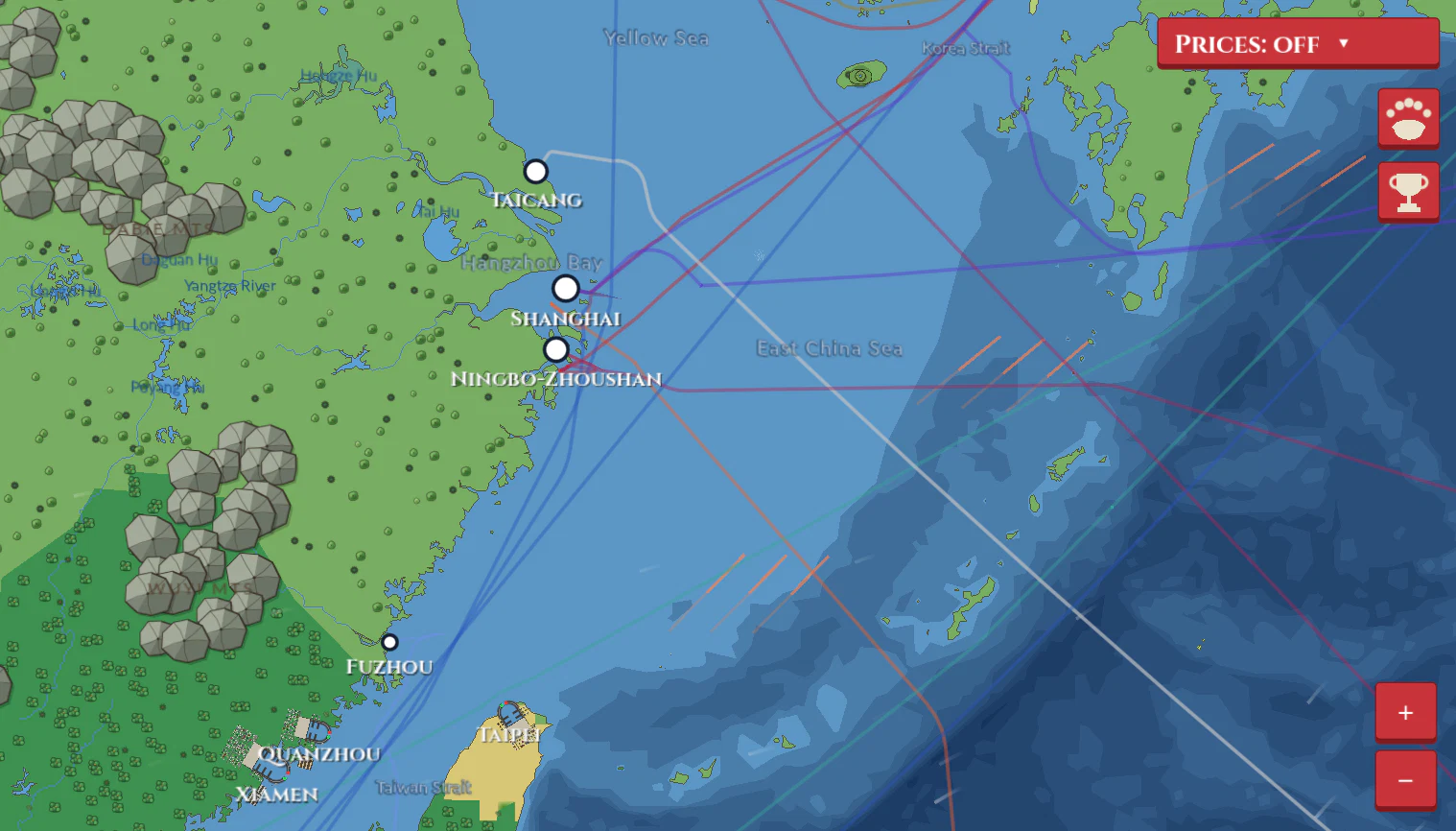
Markets tab: pick a commodity to see the cheapest ports to buy it, the most expensive to sell, and the best trades anywhere and within 800 nm (port names go to the map). The port popup shows every commodity's buy and sell price there (green cheap, red expensive). The World map's Prices picker has two columns: Price boxes, a ship line's prices in a box over each port (see the map's top right, below), and Port colors, every commodity grouped by its ship line with the line's swatch (containers orange, tankers teal, ore grey, grain gold, livestock pink, vehicles blue: the line's middle ship's map color, brightened a little), each seafood family with a little drawing of one of its species instead, on the menu and on the button: picking one colors every port by its price, green where it's cheap, white about its world average, red where it's expensive, looked at again every second as prices drift; a port grown into its marina gets a ring in its color round its jetty instead, and by night its town's glow takes the color. The menu opens lined up with the button's right edge, and the chosen line's or commodity's name is shown in its color on the button. The route screen shows what each leg would load and its expected profit, or, for a leg with nothing worth carrying, that it sails empty and about what that costs in fuel and repairs (in red: "nothing to trade: sails empty, about -$184 in fuel and repairs"), at the arrival port's prices less any hub discount there.
 Maritime Empire