 Maritime Empire
Cruise lines
Added or changed on 15 October 2026
- Ten cruise ships in two lines: Ocean cruisers (Coastal Cruiser 200 guests $1.2M, Island Hopper 700 $6M, Panamax Liner 2,000 $25M Medium port, Grand Liner 4,000 $90M Large, Mega Liner 6,500 $250M Giant; 2 to 10 amenity slots) and Expedition cruisers (Expedition Yacht 40 $1.5M, Polar Explorer 100 $7M, Ice Cruiser 200 $25M, Expedition Liner 300 $70M, Polar Flagship 450 $180M; ice class from the Antarctic stations and icebound Arctic ports in season up to the Arctic routes without an icebreaker; helipads on the two biggest; any port). Crews: the tier's officers plus a hand for every 5 guests, times the Crew service level. On the map each cruise ship wears its hull colour, an accent stripe down both sides, its deck colour, and its company's logo on the funnel.
- Round trips: a cruise ship's route is its itinerary, the first port its home port (the HQ, a hub, or a port with the company's cruise terminal: $2.5M for the first, $5M each after, built from the Cruise planner), the rest its ports of call, sailing home after the last. At home it takes bookings till its departure rule says go: after 1, 2, 3, 5 or 7 days; at 50, 60, 75, 90 or 100% full; or both (once at the fill it books on till the days are up or it's full; at the days it sails however full). Its guests' tickets are paid as it sails; each port of call charges $6 a guest (none at the company's own hubs) and pays excursion commission (more near wonders and at polar ports); a port of call a storm has closed is sailed past; back home the guests' onboard spending comes in (more with spa, casino, shops...), its supplies, entertainment and amenity upkeep are paid by the guest-night (by the Food and Entertainment levels; "Cruise supplies" in the totals), it earns XP for guests x miles, and the voyage gets a review (guest experience 30%, the itinerary 25% less any ports missed, value for money 25%, how smoothly it went 20%). A breakdown on a voyage refunds 15% of its tickets, a loss 75% (40% if it's rescued).
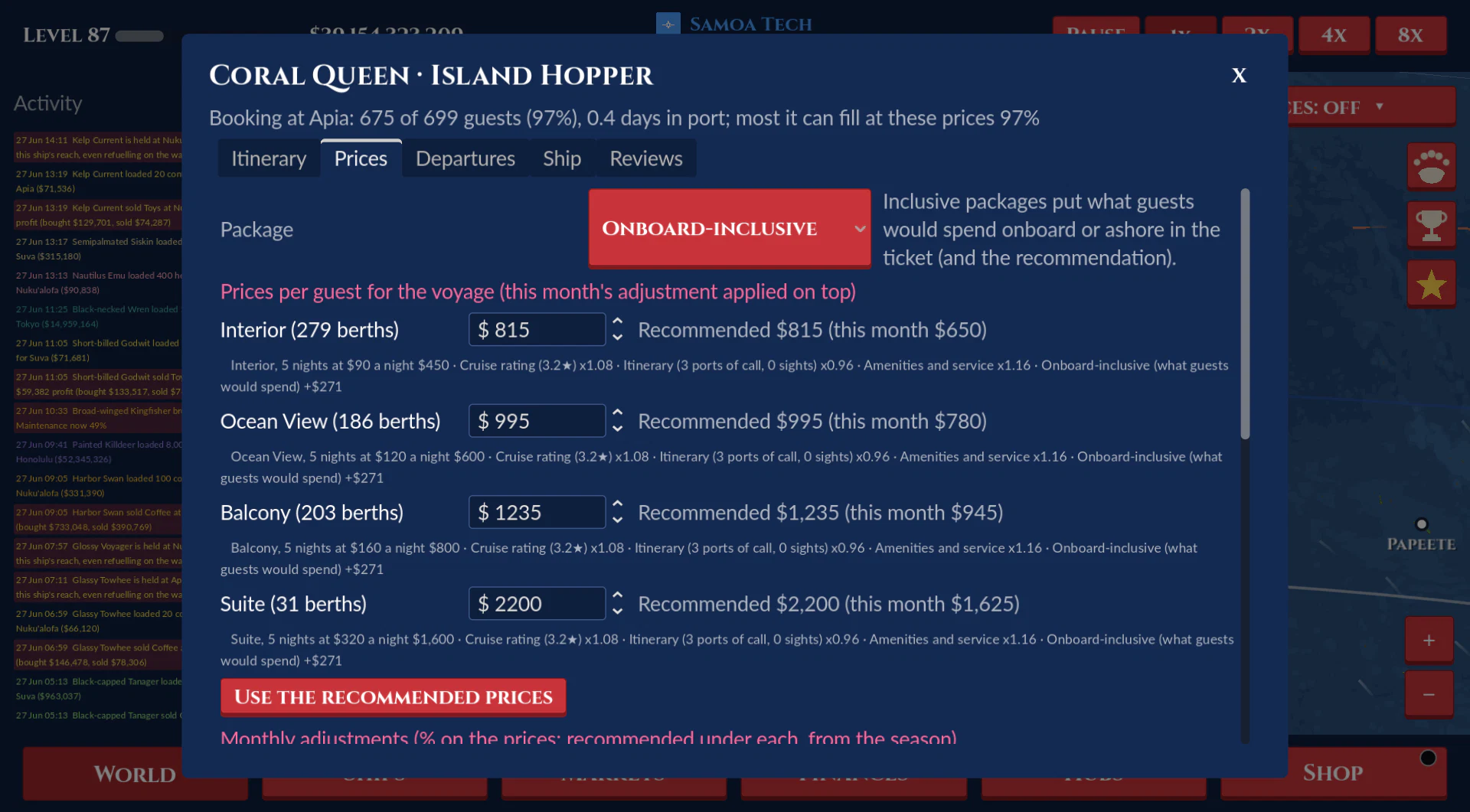
- Prices: a price per guest for the voyage for each cabin class (Interior, Ocean View, Balcony, Suite), and a monthly adjustment (-50% to +50%) for each month; a package (cruise only, onboard-inclusive, excursions-inclusive, all-inclusive) puts what guests would spend in the ticket. The recommended price is shown with every factor: the class's price a night x the nights (Expedition x4), x the Cruises rating, x the itinerary (ports of call up to 4, sights near them, market regions, polar ports for Expedition), x the season, x amenities and service, plus the package; the recommended monthly adjustments follow the season of the itinerary's port furthest from the equator (Caribbean winters, European and northern summers, the Antarctic summer, the southern hemisphere, Asia, the tropics). A ship's prices and adjustments follow the recommendations (on a new itinerary and before each voyage books) till the player sets their own; Use the recommended... puts them back.
- Bookings: a home port's would-be cruisers a day are 30 x its size x its season, shared by berths among the cruise ships booking there; a class books toward its ceiling, the share of its berths that will pay its price against the recommendation (about 90% at it, 60% at +25%, 30% at +50%, almost none at double; all of them 15% under). The Cruise planner shows the pool, the ship's share and each class's ceiling.
- Customization: the cabin mix as shares of the ship's cabin space in 5% steps (an Interior guest takes 1 unit, Ocean View 1.25, Balcony 1.6, Suite 3: more suites, fewer guests); amenities in its deck slots (Ocean: pool deck, theatre, spa, casino, specialty dining, kids' club, waterslide park, nightclub, shops; Expedition: zodiac fleet, lecture hall, observation lounge, spa, dining, shops, kayaks), each with its cost, upkeep, onboard spending and guest experience; looks (hull and stripe in any company colour; teak, white or blue decks). These change in a refit, at the HQ or a hub, paid at once and out of service for half a game day plus a quarter a change. Service levels (Food, Crew, Entertainment: Basic, Standard, Good, Premium, Luxury) change any time.
- Guest experience (0-5): amenities for its deck slots, premium cabins (Balconies and Suites), service levels, less crowding, which only comes with a ship packed full of Interior and Ocean View guests (never with over half the space in Suites).
- The Cruise planner (a cruise ship's popup): Itinerary (home port, terminal, ports of call and their sights, nights, miles, appeal, season by month; Edit itinerary opens the route screen), Prices (package, prices against recommendations with their factors, monthly adjustments against theirs, the bookings outlook), Departures (the rule; a warning when a fill can't be reached at the prices), Ship (service levels; the refit: cabins, amenities, looks, its cost and days and the experience it makes) and Reviews (its last voyages' money and reviews). A cruise ship's status says how booking is going or where it is on its voyage.
- The Cruises rating's parts: guest experience (the fleet's average), itinerary (average appeal), reliability & safety (maintenance; incidents and ports missed per voyage) and value & reviews (the average of recent reviews).
- AI rivals with Cruises buy the biggest cruise model they can afford twice over (one more every 10 levels), fit its deck slots, and sail it from a hub to up to 3 of the most appealing ports within reach at the recommended prices. The tutorial has "Plan a cruise" and "Tickets and reviews" tips, and a Cruises start gets its own welcome.